Expertise
How to turn your boldest packaging concepts into tangible objects through co-creation and prototyping
5 February 2026
Bridging the gap between vision and reality
You have imagined an innovative packaging concept. Your vision is clear, your business case is compelling, but between concept and production lie a host of technical unknowns, material uncertainties and market risks.
It is in this gap that innovation is lost. Not for lack of ambition, but through an inability to validate feasibility before committing to costly tooling and production cycles. Traditional development processes force you to make critical decisions based solely on renderings and specifications, wagering a significant investment on untested assumptions about how unconventional materials will perform in real conditions.

The benefits of co-creation
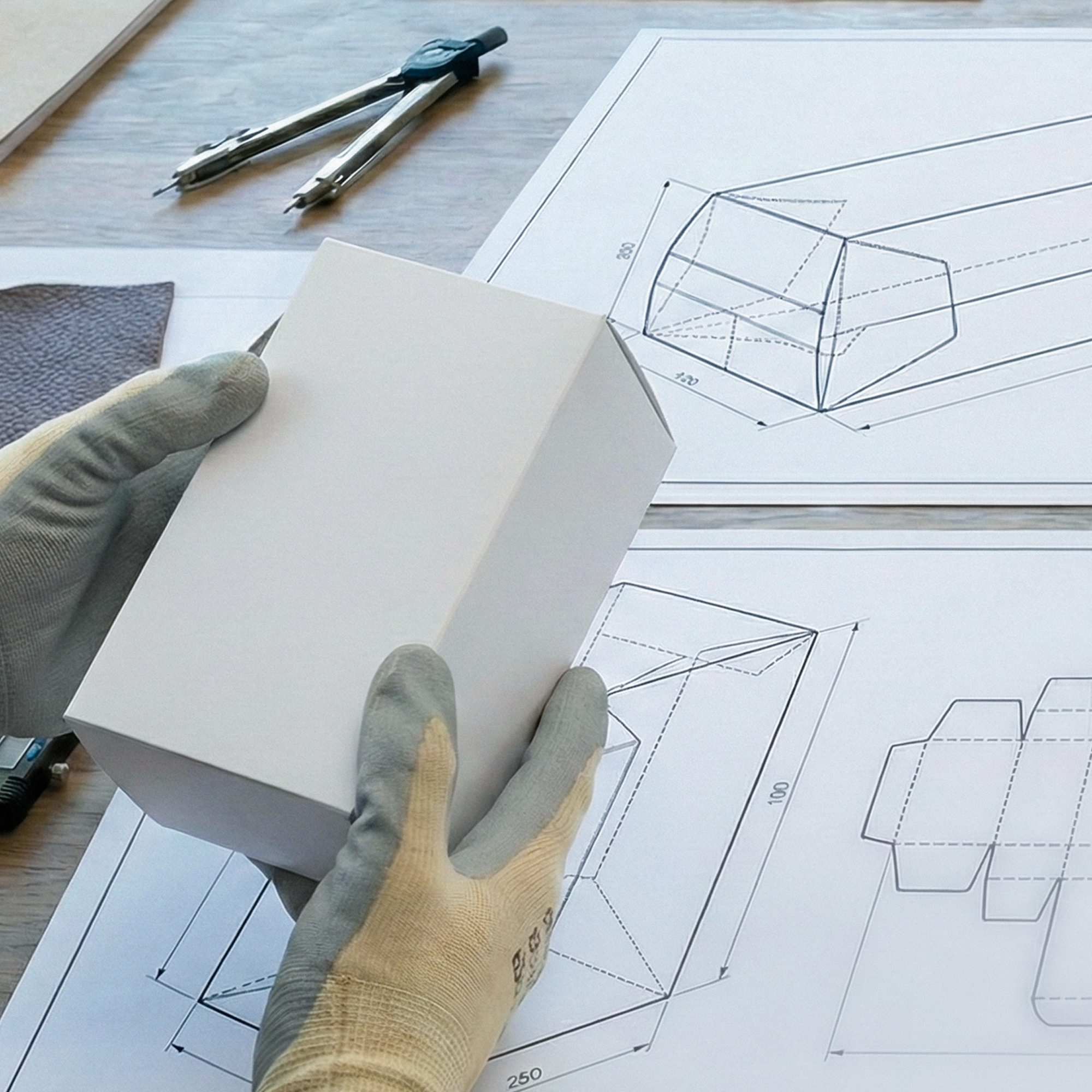
Polythink’s co-creation methodology eliminates this risk. We turn abstract concepts into physical prototypes that you can hold, test and validate before making irreversible commitments. Through collaborative co-creation and rapid prototyping technologies, we compress months of uncertainty into days of tangible progress, ensuring that your packaging innovations reach the market with proven technical feasibility and minimised adoption risks.
50%+
Time saved in prototype manufacturing thanks to digital technologies
25%+
Higher adoption rate achieved by products co-developed during the prototyping phase
+
Multidisciplinary collaborative teams make more relevant, data-driven decisions
Co-creation as a strategic accelerator
The partnership that secures innovation
Packaging innovation demands expertise that spans several disciplines. Materials science to understand the behaviour of rubber under stress. Engineering knowledge to ensure the structural integrity of metal composites. Design sensibility to preserve aesthetic appeal while integrating technical requirements. Manufacturing insight to confirm production scalability.
No single individual possesses this breadth of knowledge. That is why Polythink’s co-creation methodology is centred on multidisciplinary collaboration. Our team of Solution Finders brings together specialists in packaging engineering, packaging and materials, industrial design and production technology. When you bring your concept, you are not presenting to a single decision-maker. You engage with a collaborative team equipped to evaluate your vision from every critical angle simultaneously.
Research demonstrates that multidisciplinary collaborative teams make more relevant, data-driven decisions. This is not merely efficiency. It is risk mitigation through comprehensive expertise. You receive integrated solutions rather than sequential problem-solving that lengthens timelines and compounds uncertainties.
Your engagement with Polythink begins with a transparent dialogue. You share your vision, your constraints, your market objectives. Our team of Solution Finders asks in-depth questions about intended use cases, environmental conditions, regulatory requirements, production volumes. A collaboration where your market knowledge combines with our technical expertise to sharpen the concept before prototyping begins.

Compressing months into days
What will survive drop tests while remaining cost-effective at scale? Does your innovative closure mechanism work reliably across different temperature ranges? Rather than theorising the answers, we create physical objects that provide empirical evidence.
Throughout this process, decisions emerge from collective expertise rather than individual authority. Your input as brand owner and market expert carries the same weight as our technical assessments. This partnership approach ensures that solutions honour both the creative vision and practical reality, producing innovations that succeed commercially because they are technically sound and technically advanced because they respect market needs.
Explore, iterate, realise: the prototyping approach

Prototyping makes it possible to move forward methodically while staying highly responsive. From the very first versions, it reveals aspects impossible to anticipate from plans alone: a texture, an ergonomic balance, a manufacturing constraint or a functional detail.
Each stage brings concrete adjustments. This development rhythm makes it possible to explore, refine and gradually converge towards a more accurate solution, one that is at once aesthetic, technical and feasible.
Polythink supports this process through integrated expertise in materials and processes. When adaptations are needed, our teams can quickly propose alternatives, adjust the design and validate the changes with new prototypes.
Beyond design, this approach also makes it possible to confirm industrial feasibility before any production commitment. Our prototypes are fully functional and produced under real-world conditions, to thoroughly test assembly, durability and tolerances.
In this way, each validation rests on a proven solution, built step by step.

From technical success to market adoption
Technical feasibility is necessary but insufficient. Your packaging innovation must succeed in the market, which requires more than structural integrity and manufacturing viability. It must resonate with consumers, differentiate your brand, justify positioning and deliver the experience your strategy promises.
Physical prototypes enable a validation that no rendering can provide. When you hold the rubber-coated bottle you imagined, you assess whether it delivers the desired tactile experience.
More importantly, physical prototypes allow you to test with real consumers and stakeholders before finalising the design direction. Focus groups can touch, open and interact with the prototypes. Retail partners can assess shelf presence and handling. Your internal teams can evaluate production implications and logistical requirements. This immersion into physical reality surfaces insights that transform good concepts into market-winning products.
Perhaps the greatest commercial advantage that physical prototyping provides is confidence. Confidence to present innovations to retail partners, backed by tangible prototypes rather than concepts. Confidence to commit marketing resources to a positioning strategy that highlights the material innovation you have validated. Confidence to invest in scaling up production knowing you have eliminated the critical unknowns.
This confidence translates directly into commercial success:
- Sales Enablement : Your team approaches buyers with prototypes that can be handled and evaluated, not just images on a screen.
- Marketing Authenticity : Your campaigns create expectations around the tactile experiences consumers will actually receive, not aspirational renderings.
- Operational Alignment : Your production team prepares for manufacturing knowing the design is validated, instead of hoping it will work.
- Launch Confidence : When you reach the market, you are not hoping the response will match projections. You have tested with real users and refined based on feedback.
The co-creation methodology with Polythink
Exploration
Transparent dialogue between your market expertise and our technical knowledge to refine the vision into achievable specifications with confirmed material feasibility.

Collaborative iteration
The multidisciplinary Solution Finders team evaluates concepts from the perspectives of engineering, materials, design and production simultaneously for integrated solutions.

Prototypage
Advanced additive manufacturing and manufacturing technologies turn digital designs into physical prototypes in a matter of hours, enabling multiple iterations per week.

Material validation
Accelerated testing simulates market conditions, validating the performance of atypical materials under stress, environmental exposure and repeated use.

Market testing
Physical prototypes enable authentic consumer feedback, stakeholder evaluation and retail-partner assessment before design finalisation and tooling commitment.

Production-ready
Validated prototypes confirm manufacturing feasibility, cost-effectiveness and scalability, eliminating technical risks before production investment.
More articles

How smart traceability (Blockchain, RFID) protects your brand’s integrity, from design to unit-level tracking
Your brand thrives on innovation. Whether pioneering unconventional materials, such as packaging for luxury spirits with a rubber finish or designing metal-accented cosmetics cases, your designs set you apart in saturated markets. Yet this very differentiation creates a critical vulnerability: the more distinctive and valuable your packaging becomes, the more attractive it is to counterfeiters.
Discover
Reducing innovation risks through packaging prototyping
Innovating is a strategic necessity in the packaging industry, but failure is costly. In this highly competitive sector, a failed launch can impact an entire value chain: millions of euros invested, missed time-to-market, and a tarnished brand image.
Discover
How to turn your boldest packaging concepts into tangible objects through co-creation and prototyping
You have imagined an innovative packaging. Your vision is clear, your business case is compelling, but between concept and production lie a host of technical unknowns, material uncertainties and market risks.
Discover